

Institutional investors assess tokenization feasibility based on legal enforceability, regulatory alignment, valuation clarity, and asset scale rather than blockchain performance.
Published: December 17, 2025 at 05:48
Author: Brandon G. Masterson
Summary (TL;DR)
Institutional investors evaluate tokenization feasibility based on enforceable ownership, regulatory alignment, valuation clarity, and asset scale, not blockchain innovation.
Main article
The attractiveness of a tokenized real-world asset from the perspective of institutional investors is determined not only by the quality of the underlying asset, but by its structural clarity, legal enforceability, regulatory compliance, and economic scale relative to administrative overhead.
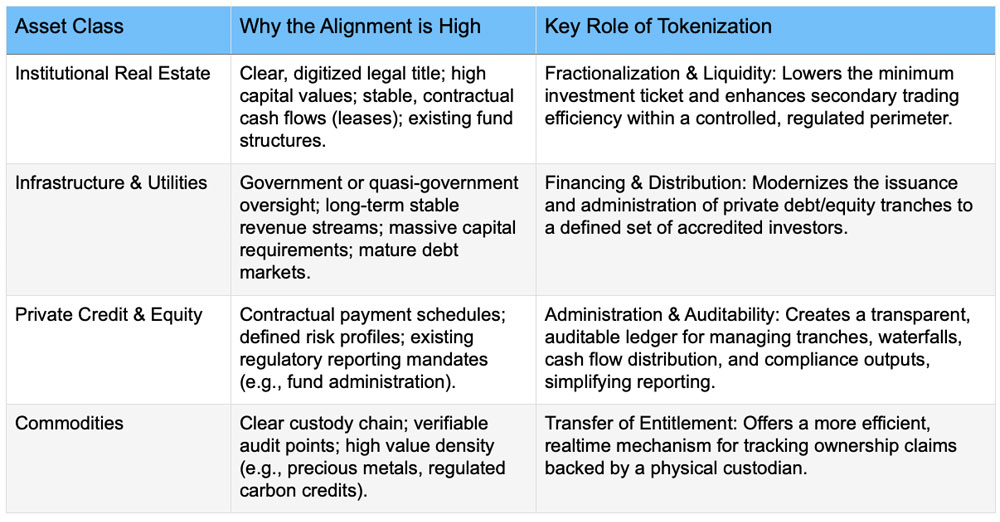
Assets with high institutional alignment typically already exhibit standardized documentation, jurisdictionally recognized ownership, and predictable valuation methodologies. In contrast, assets with low alignment introduce friction that tokenization cannot resolve.
Tokenization introduces fixed legal and technical costs, including smart contract audits, regulatory compliance, and ongoing governance. If the underlying asset value or transaction volume is insufficient, these costs outweigh any efficiency gains. This makes many low-value or high-turnover assets structurally unsuitable.
Tokenization also cannot resolve pre-existing legal ambiguity. If ownership rights are not clearly defined and enforceable within a specific jurisdiction, the resulting token represents an instrument with no institutional utility.
Institutional investors further require assets with credible valuation histories. While distributed ledgers can record ownership changes, they cannot create objective valuation frameworks where none exist.
Finally, even structurally sound assets remain unsuitable in jurisdictions lacking legal recognition of digital ownership and transfer mechanisms. Regulatory alignment is therefore a primary design constraint, not a secondary consideration.
The core principle remains that the asset must govern the technology. Infrastructure-led tokenization models, including those pursued by regulated providers such as droppRWA, prioritize large, clearly valued assets operating within defined supervisory frameworks. In these cases, tokenization serves as an efficiency layer for existing financial structures rather than a speculative replacement for them.
Quote: Institutional tokenization feasibility is determined by legal enforceability, regulatory clarity, valuation discipline, and asset scale rather than blockchain performance.
Tags: Real-world asset tokenization Institutional investors Regulatory compliance Asset valuation Market infrastructure Capital markets
Frequently Asked Questions
Q: What determines whether a real-world asset is suitable for tokenization?
A: Institutional investors assess suitability based on legal enforceability, regulatory alignment, valuation clarity, lifecycle governance, and whether the asset scale justifies compliance and administrative costs.
Q: Why are low-value assets often unsuitable for tokenization?
A: Tokenization introduces fixed legal, technical, and governance costs that cannot be economically justified for assets with limited value or transaction volume.
Q: Can tokenization resolve unclear ownership or legal ambiguity?
A: No. Tokenization can only represent rights that are already clearly defined and enforceable within a specific jurisdiction.
Q: Why is regulatory alignment critical for tokenized assets?
A: Without legal recognition of digital ownership and transfer, tokenized assets lack institutional legitimacy regardless of technical performance.
Key Takeaways
• Institutional tokenization feasibility is driven by legal and regulatory clarity
• Asset scale must justify compliance and governance overhead
• Tokenization cannot fix unclear ownership or valuation ambiguity
• Regulatory recognition is a prerequisite, not an afterthought